
Cutting edge publications and research
from the IVF Academy Team.

Interpreting IVF Statistics: What Clinicians Need to Know
TL;DR: IVF statistics only become meaningful when clinicians understand what was measured, which patients were included, and where the denominator begins. Accurate interpretation supports clearer counseling, stronger laboratory review, and more responsible comparisons between outcomes.
- Live birth rates per transfer, retrieval, and cycle start answer different questions and should never be treated as interchangeable.
- Cumulative success rates reflect multiple transfer opportunities from one retrieval, so they are usually higher than first-transfer rates.
- IVF fertilization rate is an early laboratory metric, not a substitute for blastocyst development, implantation, or live birth.
- IVF failure rate should be defined by stage, since cancellation, failed fertilization, embryo arrest, and failed implantation represent different events.
- Stage-based analysis helps laboratory professionals identify meaningful trends, communicate results more confidently, and connect data with practical quality measures.
IVF statistics carry real clinical weight because of their place at the intersection of data and human expectations. Patients often hear a success rate and believe it applies universally. Simultaneously, laboratory teams may see an IVF fertilization rate and view it as evidence of technical performance.
Neither interpretation is complete without a lot more context.
Continue reading to learn how to turn IVF statistics into meaningful information that can be used to make compassionate patient care decisions.
Why the Denominator Changes the Meaning of IVF Statistics
Every IVF rate compares an outcome with a starting group. That starting group is the denominator, and it determines what the percentage actually tells you.
A live birth rate per embryo transfer measures how many transfers led to a live birth. A live birth rate per retrieval begins earlier and includes patients who retrieved oocytes but never reached transfer. A rate per cycle start begins even earlier than that, capturing cancellations that occurred before retrieval.
Consider a clinic that reports 40 live births from 100 embryo transfers. Its live birth rate per transfer is 40%. If those transfers came from 150 retrievals, the live birth rate per retrieval is about 27%.
Neither figure is incorrect. They simply answer different clinical questions.
The CDC’s ART surveillance data provide useful national context. In 2022, 435,426 ART cycles were performed among 251,542 patients at 457 reporting clinics. Those cycles resulted in 94,039 live-birth deliveries.
The totals above describe the national use and impact of assisted reproductive technology, but do not represent the IVF odds of an individual patient.
Per-Transfer Success Is Different from Cumulative Success
Patients may undergo more than one embryo transfer from a single retrieval. Cumulative live birth rates account for outcomes from the fresh transfer and subsequent frozen transfers connected to that retrieval.
This explains why cumulative success is commonly higher than first-transfer success. The cumulative figure reflects several opportunities for pregnancy created by one retrieval, but doesn’t mean that every individual transfer carries the cumulative probability.
Age is also an important part of interpretation. In SART’s finalized 2023 national report, patients younger than 35 using their own eggs had a 53.2% live birth rate per intended retrieval after all linked transfers within the reporting period. The first-transfer live birth rate for the same age group was 39.4%. Among patients ages 38 to 40, the corresponding rates were 26.2% and 21.3%.
Ultimately, when discussing how effective IVF is, clinicians should clarify whether the answer refers to one transfer, one retrieval, or the complete use of embryos from a retrieval. That ultimately gives patients a more realistic view of the treatment pathway.
How to Interpret an IVF Fertilization Rate
The IVF fertilization rate measures an early laboratory outcome. It shouldn’t be treated as a substitute for blastocyst development, implantation, or live birth.
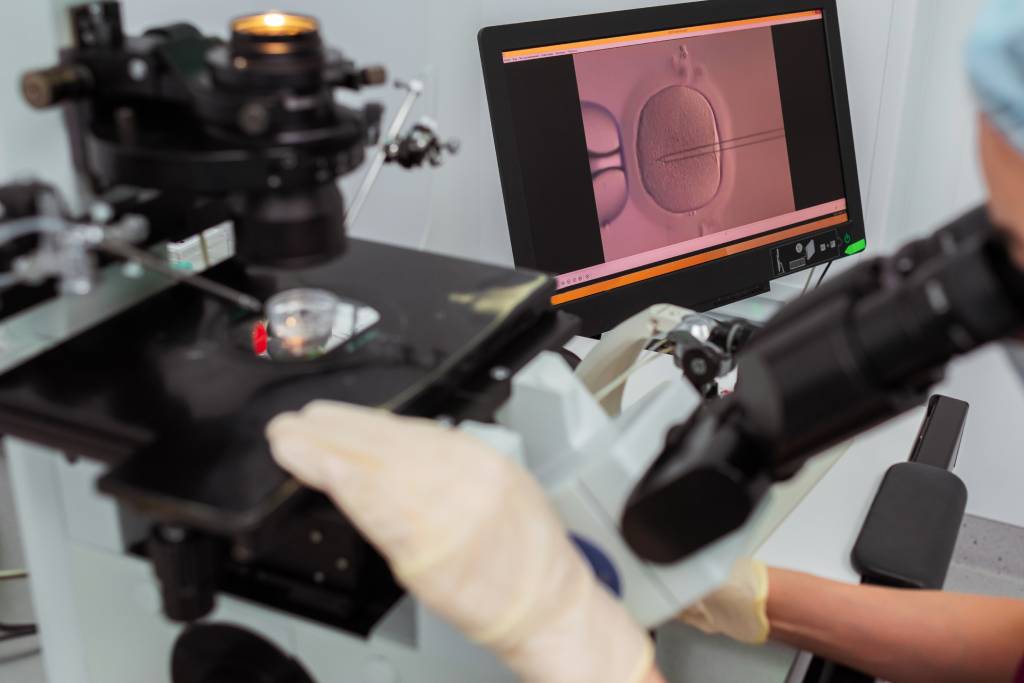
For conventional IVF, the calculation usually compares normally fertilized oocytes with the oocytes inseminated. Normal fertilization is generally identified by the presence of two pronuclei. For ICSI, the denominator should be the number of mature metaphase II oocytes injected rather than every oocyte retrieved.
The ESHRE and Alpha laboratory consensus identifies a normal fertilization competence value of at least 60% for conventional IVF. The aspirational benchmark is 75%. For ICSI, the respective values are at least 65% and 80%. These benchmarks are designed for laboratory quality management rather than individual patient prediction.
A review of ICSI success factors can help laboratory professionals assess which variables are controllable and which reflect the biology of the case.
The IVF Failure Rate Must Be Defined by Stage
The phrase IVF failure rate can refer to several very different outcomes:
- A cycle may be canceled before retrieval.
- Retrieved oocytes may fail to fertilize normally.
- Embryos may arrest before reaching the blastocyst stage.
- A transferred embryo may not implant.
Combining these events into one failure percentage hides where attrition occurred. It may also direct attention toward the wrong clinical or laboratory process.
A more useful review should aim to follow the cycle in sequence, examining the proportion of retrieved oocytes that were mature, then measure normal fertilization among eligible oocytes. Blastocyst development and cryosurvival can be evaluated before considering implantation or live birth outcomes.
This stage-based approach helps clinicians explain that a favorable result early in the cycle does not necessarily guarantee success later.
Turning IVF Results Into Better Decisions
Interpreting IVF statistics accurately helps laboratory professionals communicate results with greater confidence. IVF Academy’s laboratory courses connect these data points to the practical workflows and quality measures used in the IVF lab.
Are you ready to improve your confidence and transform the way you communicate about IVF statistics? Take our clinical fertility courses and expand your skillset.